Recycling and Sustainability — Gardeners Marylebone Commitment
At Gardeners Marylebone we place the eco-friendly waste disposal area at the heart of our work. Our Marylebone gardeners and gardening teams aim to create a practical, sustainable rubbish gardening area across private and communal green spaces. We focus on reducing landfill, boosting reuse and improving soil health, while aligning with borough approaches to waste separation.
Our Recycling Ambition and Targets
We have set a clear recycling percentage target: 65% diversion from landfill by 2028 across all our services in Marylebone and neighbouring wards. This target covers green waste composting, wood and timber reuse, and responsible disposal of non-organic waste. Gardeners in Marylebone are trained to segregate materials at source, matching the local borough guidance for food, glass, mixed recycling and residual streams.
How We Manage the Eco-Friendly Waste Disposal Area
Our teams operate designated on-site sorting zones so that soil, prunings, pots, and other garden detritus are separated immediately. This reduces contamination and improves recycling rates. Marylebone gardening services also emphasise the reuse of materials: reclaimed paving, composted green waste, and salvaged timber are repurposed wherever possible to support the sustainable rubbish gardening area model.
 We work with local transfer stations and eco-parks that serve central London boroughs, ensuring that materials collected from Marylebone are processed responsibly. Where boroughs recommend separate food and garden waste collection or dry mixed recycling, our procedures mirror those systems to streamline municipal transfer and processing.
Our route planning connects collections directly to nearby transfer stations and consolidation points, reducing double handling and lowering emissions. We prioritise transfer facilities that accept source-separated organic waste, wood, inert materials and recyclables for reprocessing back into usable products.
Partnerships are central to our sustainability approach. Gardeners in Marylebone maintain active relationships with community reuse charities and social enterprises to redirect usable items — pots, tools, furniture offcuts — into local projects. Our collaborations support circular economy principles and provide resources to community gardens and allotments.
We also partner with specialist recycling centres and waste transfer operators that handle garden-specific streams. These partnerships ensure that Marylebone gardeners can offer responsible disposal options for mixed garden waste, soil screening, and inert materials while complying with borough-level waste separation schemes.
 To reduce our transport carbon footprint we operate a fleet of low-carbon vans: electric vehicles for short urban trips and hybrid models for longer journeys. Efficient load consolidation and smart routing software minimise vehicle miles, helping us lower overall emissions while maintaining reliable garden clearance and maintenance timetables.
Our on-site staff receive training in waste hierarchy principles: reduce, reuse, recycle, and recover. This means pre-emptive planning to avoid unnecessary removals, reuse of good condition materials, and careful segregation so recyclables are clean and marketable. Using these methods, the sustainable rubbish gardening area becomes a practical reality in the central London context.
Key elements of our approach include:
- Segregation at source to match borough separation guidelines for organics, dry recycling and residual waste
- Composting and soil reuse to keep nutrients on-site where appropriate
- Partnerships with reuse charities and community gardens to extend material life
- Use of electric and low-emission vans to transport materials to transfer stations
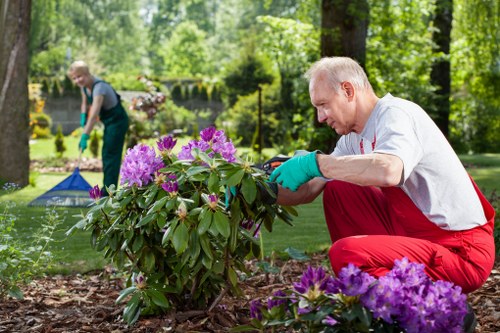 The benefits are tangible: reduced disposal costs, lower haulage emissions, enhanced biodiversity from nutrient-rich compost, and stronger community links. Our work with Westminster and neighbouring boroughs respects local recycling schemes—where households separate food waste, paper, glass and mixed recycling—and we adopt those same practices in our professional green waste management.
To support long-term change, Gardeners Marylebone documents waste flows from each project and reports on progress toward our recycling percentage target. Regular audits and collaboration with transfer stations help us identify opportunities to increase reuse and capture higher-quality recyclable streams for processing.
We prioritise transparent operations: clear labelling in our on-site eco-friendly waste disposal areas, staff guidance aligned to local authority guidance, and proactive reuse pathways with charities and social enterprises. This reduces the risk of contamination and maintains high standards for the sustainable rubbish gardening area we champion.
By combining practical on-site segregation, targeted partnerships, and a low-carbon transport strategy, Marylebone gardening services deliver a resilient, circular approach to garden waste. Our goal is simple: greener streets, healthier soils, and measurable reductions in landfill through responsible, local recycling and reuse.

